
How Hydrogen-Electric Fuel Cell Technology is changing the game for Buses or Coaches: Transitioning to High-Performing, Scalable, Zero-Emission Mobility

Decarbonizing transport ation is a major challenge for operators of urban, interurban, and long-distance buses. Hydrogen fuel cell technology offers a best-of-both-worlds solution for bus and coach applications by combining the performance, ease of use, and competitiveness of internal combustion engines with the environmental benefits of battery-electric alternatives—delivering zero emissions of CO₂ and NOx in operations.
Key Benefits of Fuel Cell Technology for Buses and Coaches
1. Compact Design That Preserves Passenger Capacity
Hydrogen fuel cell systems are highly compact and powerful density devices. This allows easy integration into various bus architectures, whether in the engine bay or on the roof—while maintaining onboard energy density and preserving passenger capacity . A fuel cell powertrain can be integrated either as original equipment by OEMs or retrofitted by integrators or fleet operators to convert conventional diesel vehicles into hydrogen-electric models. This is why fuel cells are ideal solution for decarbonizing bus and coach applications where space, performance, and efficiency make the difference.
2. Fast Refueling and Long Range for Maximized Uptime
With millions of kilometers of on-road experience, the industry has demonstrated that Fuel Cell Electric Buses (FCEBs) offer the operational flexibility of diesel buses. They refuel in less than 15 minutes and can travel up to 350 km on a single fill. This enables continuous service and centralized refueling for the entire fleet thus reducing the infrastructure complexity and investment.
3. Dependable in demanding topography and climate conditions
Fuel cell systems operate very efficiently in difficult topographical and ambient temperature conditions. They deliver high torque at low speeds (or constant torque?), making them suitable for steep or hilly terrains which require responsive power supply. Their thermal management systems enable stable performance withing a large temperature amplitude, from negative to very warm.
4. A Scalable and Cost-Efficient Technology
The fuel cell technology for hydrogen electric buses and coaches is already industrialized, largely available, and with proven efficiency. It offers low fuel consumption, long-term durability with minimal maintenance requirements. It becomes affordable and as production scales and infrastructure expands, costs are expected to decrease further.
5. Truly Zero Emissions at Use
Hydrogen fuel cell buses emit no CO₂, NOx, or particles — only water vapor and heat. They combine the smooth driving experience of electric vehicles with the robust performance of combustion engines, making them a key enabler of clean, sustainable public transport.
Symbio, driving the hydrogen-electric transition with advanced fuel cell solutions tailored for buses and coaches
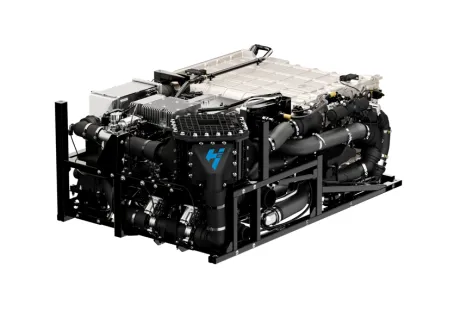
At Symbio, we partner with OEMs, integrators, and fleet managers to support every stage of their transition to hydrogen-electric mobility. Our plug-and-play StackPack™ 75 system combines industrial readiness with technical excellence. It is designed to offer the optimal balance between performance and cost-efficient integration and fleet operations, supported by our end-to-end service approach. We support our clients all over their transition to hydrogen-electric mobility, from design, architecture development, integration and pre-production, all the way to mass-production.
Do you want to learn more about our solutions?